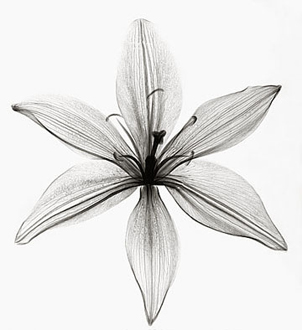
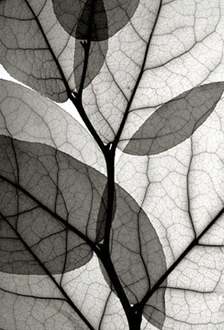
X-rays were discovered by Wilhelm Roentgen in 1895, and their usefulness in medicine was immediately recognized worldwide. Within two years there was a New York Radiology Soceity, and with the discovery of better and safer equipment and now computer augmentation, the field has expanded logarithmically, even as non-X-ray imaging devices (ultrasound and magnetic resonance) became available.
The first published X-ray of a leaf was by Goby1, a French scientist, in 1913. Hall Edward2 in 19I4 was the first to image a flower, and Engelbrecht3 entered the field in 1931. It was Dain Tasker4,5, a California physician radiologist, however, who popularized the technique. He had gallery shows in the 1930's, and a large number of his images can be seen in a recently published book6.
In the 1920's, Man Ray, an American artist and photographer made images he called Rayographs. They were photograms, made by shining white light onto objects placed on light sensitive photo paper. The backgrounds were black, and the some of the objects translucent, so they looked like X-rays, and some consider him to be a pioneer in X-ray art, but that is not true. According to Timothy Baum7 of the Man Ray Trust, Ray never used X-ray or other ionizing radiation to make images.
Beginning in 1960 Albert G. Richards8, now Emeritus professor of Dentistry at Univ. of Michigan School of Dentistry began making X-ray images of flowers, and a large number of them can be seen in his book9 , published in 1990.
In 1963 Sherwood and Seemann10 of the Kodak Research Laboratory published an article describing the technique of floral radiography.
William A. Conklin of Orangeburg, South Carolina, started making X-ray images of sea shells in the 1970's and his first show was in 1978 at The Museum of Natural History of the Smithsonian Institute Washington, D.C. His work can be seen in a book published in 199511.
My involvement began in the 1970's when as an academic surgeon at LSUMC I began studying the vascularization of the healing wound, using an X-ray technique called microangiography. To pursue this work I secured an NIH grant which allowed me to purchase a precision X-ray machine (Faxitron). My early images of blood vessels growing into tissue12 looked like abstract paintings —see facing page, and unaware of the work above, I began to make X-ray images of flowers and shells, incorrectly thinking I was the first in the world to do so. There is an old saying in academic surgery that "if you think you have discovered a new procedure (operation), all it means is that you have not read the German literature". In this case it was the French!
After I had worked out some of the technical difficulties in X-ray photography as art and to encourage others to get into the field, I published details of the technique in 198313, and Steve Meyers18 used the article to begin his work.
Merrill Raikes has an excellent review of the history of X- ray art on his WEB page23.
In 2006 other practitioners of X-ray art that I am aware of are William Conklin11, Don Dudenbostel14, George Green15, Albert Koetsier16, Judith McMillan17, Steve Meyers18, Sonny Randon22, Albert Richards9, and Merrill C. Raikes19 in the USA, and Nick Veasey20 and Hugh Turvey 21 in the United Kingdom. Examples of their work and contact information can be found in the final section of this book.
----------------------------------------------------------------------------------
About X-ray Photograph of flowers by Steven N.Meyers. He says of his work :
My introduction to the photographic process began in 1971 when I began formal studies for radiological technology. I have made my living creating radiology-based images in the diagnostic medical setting for the last 30 years. It was this introduction to the photographic process that led to an interest in camera based photography in the late 70s. As a diversion from my daily world of black and white, I specialized in medium and large format color landscapes and nature photography.
Around 1975, I began experimenting with making x-ray photographs of flowers and other objects mainly out of curiosity. These efforts were just for fun, but I kept the idea in the back of my mind to get serious about it someday. Well, before I knew it, 20 years had passed and the art form was almost forgotten. There have been a few other x-ray art photographers over the years, with the earliest floral radiographs made around 1914. The choice x-ray equipment for floral radiographs is almost as rare as the art form itself. Most hospital diagnostic x-ray equipment is much too powerful for recording delicate flower details.
In 1997 I became very serious about this art form and have created over 3000 different images since. Currently my collection is edited down to about 60 favorites. Most of the images fail because of composition, as there is no lens to compose the images.
Floral radiography, even in its 70 year history, is for the most part unexplored, and I am committed to seeking out new and interesting subjects in nature.
View Steven Meyers' "Garden Secrets" Exhibition -
October 13 - November 20, 2006


Steven N.Meyers